FQHC Revenue Cycle Management: Challenges, Revenue Drivers & Outsourcing
Table of Contents
- What Makes the FQHC Revenue Cycle Different?
- Key Revenue Drivers in FQHC Revenue Cycle Management
- Common Financial Challenges Facing FQHCs
- How FQHC Revenue Optimization Supports Financial Sustainability
- The Role of FQHC RCM Outsourcing
- FQHC Revenue Cycle Outsourcing: When Does It Make Sense?
- How e-care India Supports FQHC Revenue Cycle Management
- Conclusion
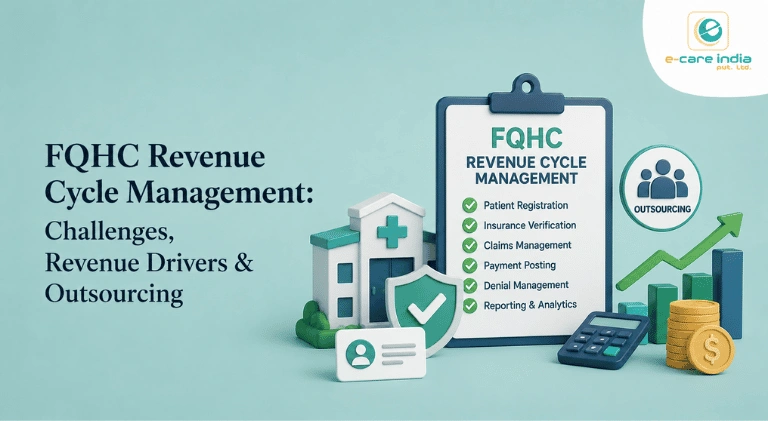
Federally Qualified Health Centers (FQHCs) play an essential role in delivering accessible healthcare to underserved communities. But maintaining financial stability while managing complex reimbursement requirements can be challenging. Revenue performance depends on much more than simply submitting claims. Patient access, encounter documentation, coding, payer requirements, claims processing, denials, and accounts receivable all influence how much revenue a health center ultimately collects.
That is why FQHC revenue cycle management has become a key focus for health center leaders.
Unlike conventional physician practices, FQHCs operate within a specialized reimbursement environment involving Prospective Payment System (PPS) requirements, payer-specific rules, sliding fee considerations, and multiple reimbursement streams. CMS maintains specific billing and payment guidance for FQHC services, including annual PPS updates. A well-managed FQHC revenue cycle can help health centers protect earned revenue, improve cash flow, and direct more resources toward their mission.
What Makes the FQHC Revenue Cycle Different?
The FQHC revenue cycle covers the financial journey from patient registration through final reimbursement. However, the process has additional complexity because FQHCs must manage reimbursement requirements that differ from many traditional healthcare organizations.
Depending on the health center, the revenue cycle may involve:
- Patient registration and eligibility verification
- Sliding fee assessment
- Encounter documentation
- Charge capture
- FQHC-specific coding
- Medicare and Medicaid billing
- Commercial payer claims
- PPS reimbursement
- Payment posting
- Denial management
- AR follow-up
- Financial reporting
Key Revenue Drivers in FQHC Revenue Cycle Management
1. Accurate Patient and Insurance Information
The revenue cycle begins before a claim is created. Incorrect demographics, inactive insurance coverage, or incomplete payer information can lead to rejected claims and delayed reimbursement.
Effective eligibility verification helps identify coverage issues before services are provided and reduces preventable downstream billing problems.
For FQHCs serving diverse patient populations, maintaining accurate insurance and financial information is especially important.
2. Complete Encounter Documentation
Documentation plays a major role in FQHC reimbursement. If an encounter is not properly documented or the services provided are not accurately reflected in the billing record, reimbursement can be affected.
A strong connection between clinical documentation, coding, and billing helps ensure that eligible encounters are captured correctly.
This is particularly important because FQHC reimbursement can depend on encounter classification and applicable payment methodology.
3. Accurate FQHC Billing and Coding
FQHC Billing requires knowledge of applicable reimbursement requirements and payer-specific rules.
Coding errors, missing information, incorrect encounter details, and incomplete claims can create payment delays or denials.
Regular review of coding and billing data can help health centers identify where revenue is being lost before small problems become larger AR issues.
4. Denial and Accounts Receivable Performance
Denied and unpaid claims can quickly become a major source of revenue leakage.
An effective FQHC revenue cycle should provide visibility into:
- Denial reasons
- Payer-specific trends
- Aging AR
- Unresolved claims
- Underpayments
- Timely filing issues
- Appeal outcomes
Common Financial Challenges Facing FQHCs
FQHCs must balance financial sustainability with their mission of serving communities, often while dealing with staffing and operational pressures.
Complex Reimbursement Rules
PPS and other payer-specific requirements can make reimbursement more complicated than standard fee-for-service billing.
Increasing Administrative Burdens
Billing teams must manage claims, denials, eligibility, documentation, payment posting, and AR while keeping up with changing payer requirements.
Shortage of Staff
A shortage of skilled billing and coding staff may delay processing.
Increasing Denial Volumes
When billing teams don’t identify recurring denial causes, they may spend significant time reworking claims instead of preventing future problems.
Limited Financial Visibility
Focusing on overall collection figures alone won’t reveal where money is lost. It has now become important to track operational drivers such as denial rates, claim quality, payor behavior, and payments.
How FQHC Revenue Optimization Supports Financial Sustainability
FQHC revenue optimization is about identifying opportunities to capture appropriate reimbursement throughout the revenue cycle rather than focusing only on collections.
Health centers can evaluate revenue performance across several areas:
- Patient access
- Eligibility verification
- Encounter capture
- Coding accuracy
- Claim submission
- Denial rates
- Payment accuracy
- AR aging
- Payer performance
For example, an increasing AR balance may not simply indicate a collections problem. It could point to eligibility errors, delayed claim submission, payer-specific denials, coding problems, or underpayments.
Analyzing the underlying cause gives health center leadership a clearer picture of where intervention is needed.
The Role of FQHC RCM Outsourcing
When internal teams struggle with staffing, claim volume, specialized billing requirements, or aging AR, outsourcing can become a strategic option.
FQHC RCM outsourcing allows health centers access to specialized resources without building every revenue cycle function internally.
An outsourcing partner may support:
- FQHC billing
- Medical coding
- Eligibility verification
- Charge entry
- Claims submission
- Payment posting
- Denial management
- AR follow-up
- Revenue cycle reporting
FQHC Revenue Cycle Outsourcing: When Does It Make Sense?
FQHC revenue cycle management outsourcing can be considered in cases where a health center faces the following:
- Denial of claims
- Claim backlogs
- Increasing AR
- Difficulties in hiring billers with experience
- Poor coding accuracy
- Lack of visibility in reporting
- Payment posting delays
- Payer requirement management issues
Outsourcing does not necessarily mean transferring the entire revenue cycle to an outside company. FQHCs can also choose a targeted model, outsourcing specific functions where internal capacity is limited.
This flexibility allows organizations to address their biggest revenue cycle challenges while retaining control over areas they prefer to manage internally.
How e-care India Supports FQHC Revenue Cycle Management
At e-care India, we understand that FQHC revenue cycle management requires specialized attention to billing accuracy, claims, denials, AR, and reimbursement workflows.
Our support can include:
- FQHC billing
- Medical coding
- Insurance eligibility verification
- Charge entry
- Claims processing
- Payment posting
- Denial management
- AR follow-up
- Revenue cycle support
Our existing FQHC-focused resources emphasize the complexity of FQHC billing and the value of specialized expertise in managing reimbursement requirements.
By combining experienced professionals with structured workflows and technology-supported processes, e-care India can help health centers strengthen revenue cycle operations while allowing internal teams to concentrate on patient care and organizational priorities.
Conclusion
FQHC revenue cycle management involves much more than just billing. It is a cohesive financial process that affects not only reimbursements but also cash flow, efficiency, and the overall sustainability of your health center.
From encounter documentation and FQHC billing to denial management and payer performance analysis, each stage can affect your financial results.
If you suffer from shortages in staffing or growing revenue cycle complexity, FQHC RCM outsourcing will offer you the help of highly qualified specialists and extra capacity.
With the right revenue cycle strategy and a reputable partner like e-care India, you can improve your financial operations, maximize your revenue potential and protect the money you already earned.
Frequently Asked Questions
What are the top services that improve FQHC revenue cycle efficiency?
Important services include FQHC billing, medical coding, insurance eligibility determination, charge capture, claims processing, payment posting, denial management, and A/R management. All these services combined will improve billing processes, improve claims processing, and improve the entire FQHC revenue cycle.
What strategies can enhance FQHC billing efficiency?
FQHC billing can be made efficient through proper patient registration, proper eligibility determination, thorough encounter documentation, special coding, fast claims submission, denials analysis, A/R management, and using technology-enabled workflows. Measuring revenue cycle performance is also useful for identifying problems.
What are the benefits of outsourcing FQHC medical billing?
FQHC RCM outsourcing can provide access to experienced billing professionals, specialized FQHC knowledge, scalable staffing, denial management support, AR follow-up, and improved reporting. It can be especially useful for health centers facing staffing shortages, billing backlogs, or increasing claim complexity.
Why is FQHC billing different from regular medical billing?
FQHC Billing has unique billing features such as the following: PPS issues, unique payer issues, encounter-based billing, and sliding scale billing. This is what makes FQHC billing more complicated compared to ordinary medical billing.