CMS Updates Telehealth Billing Requirements for RHCs and FQHCs Effective October 1, 2026
Table of Contents
- What Is Changing for RHCs and FQHCs?
- New Telehealth Coding Requirement
- How Will Medicare Payments Work?
- Why This Matters for Medical Billing Teams
- Background: Why Is CMS Making This Change?
- What Should RHCs and FQHCs Do Now?
- Preparing for the October 2026 Telehealth Billing Changes
- How e-care India Can Help
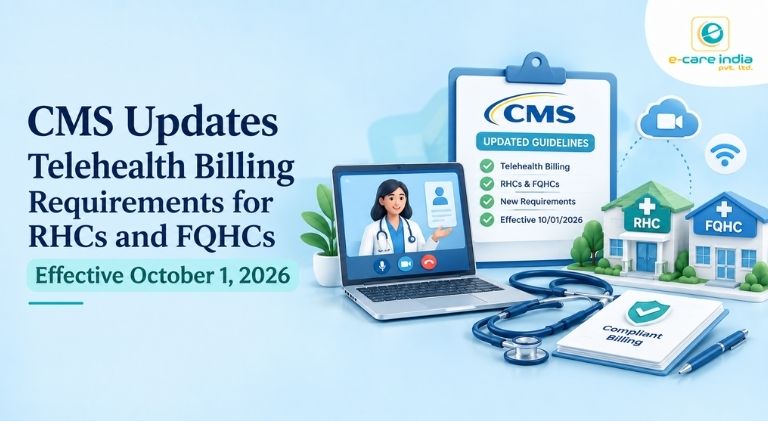
Telehealth billing requirements for Rural Health Clinics (RHCs) and Federally Qualified Health Centers (FQHCs) are changing effective October 1, 2026. Healthcare organizations and medical billing teams should review their coding and billing workflows to ensure compliance with the updated Medicare requirements.
According to the CMS MLN Matters article MM14468, RHCs and FQHCs will need to report the individual CPT or HCPCS code for the specific distant-site telehealth service provided, instead of using HCPCS code G2025.
What Is Changing for RHCs and FQHCs?
For dates of service on or after October 1, 2026, Rural Health Clinics and Federally Qualified Health Centers must bill the individual CPT or HCPCS code that describes the telehealth service provided.
This replaces the current approach of reporting HCPCS code G2025 for applicable non-behavioral health distant-site telehealth services.
The change applies to:
- Rural Health Clinics (RHCs)
- Federally Qualified Health Centers (FQHCs)
The CMS update was released on May 27, 2026, with an effective date of October 1, 2026, and an implementation date of October 5, 2026.
New Telehealth Coding Requirement
Under the updated requirements, RHCs and FQHCs should report the appropriate CPT or HCPCS code corresponding to the telehealth service performed.
CMS also specifies that RHCs and FQHCs must report the appropriate revenue code with one of the following modifiers:
- 93 – Synchronous Telemedicine Service Rendered via Telephone or Other Real-Time Interactive Audio-Only Telecommunications System
- 95 – Synchronous Telemedicine Service Rendered via a Real-Time Interactive Audio and Video Telecommunications System
This means billing teams will need to pay close attention to the type of telehealth service delivered and the corresponding code and modifier when submitting claims.
How Will Medicare Payments Work?
The CMS update also provides guidance on payment for non-behavioral health distant-site telehealth services provided by RHCs and FQHCs.
According to the update:
- Payment rates will be updated annually.
- Payment rates will be based on the average amount for all PFS telehealth services on the telehealth list, weighted by volume, for services reported under the Physician Fee Schedule.
- Payment rates will not be adjusted based on geographic locality.
- Patient coinsurance and deductibles will apply to RHC services.
- Patient coinsurance will apply to FQHC services.
- Coinsurance will be based on the lesser of the payment rate or submitted charges.
- Coinsurance and deductibles will be waived for preventive services.
Why This Matters for Medical Billing Teams
The transition away from G2025 means RHCs and FQHCs will need to ensure their billing processes are ready for service-specific telehealth coding.
Medical billing teams should review their workflows for:
1. CPT and HCPCS Code Selection
Billing staff should identify the appropriate individual CPT or HCPCS code for each eligible distant-site telehealth service rather than defaulting to G2025.
2. Modifier Reporting
The appropriate telehealth modifier should be reported based on whether the service was delivered through:
- Audio-only telecommunications, or
- Real-time interactive audio and video.
3. Revenue Code Reporting
RHCs and FQHCs should ensure the appropriate revenue code is included alongside the applicable telehealth coding requirements.
4. Billing System Updates
Healthcare organizations should review their billing and practice management systems before the October 1 effective date to ensure that outdated G2025 workflows do not result in incorrect claims.
5. Staff Training
Medical coders, billers, and revenue cycle teams should be informed about the change and understand how the new coding requirements affect claim submission.
Background: Why Is CMS Making This Change?
The update follows provisions in the Consolidated Appropriations Act, 2026, which extended telehealth flexibilities allowing RHCs and FQHCs to provide services as distant-site telehealth providers through January 1, 2028.
The Social Security Act also requires payment for distant-site telehealth services at rates similar to national average payment rates for comparable telehealth services under the Physician Fee Schedule.
Previously, RHCs and FQHCs billed Medicare Part B for applicable non-behavioral health distant-site telehealth services using HCPCS G2025. The new requirement moves billing toward reporting the individual code that describes the service actually provided.
What Should RHCs and FQHCs Do Now?
With the effective date approaching, healthcare organizations can take several practical steps to prepare:
Review current billing workflows
Identify where G2025 is currently being used for distant-site telehealth services.
Update coding guidelines
Make sure billing teams have access to the appropriate CPT and HCPCS codes for eligible telehealth services.
Review modifiers and revenue codes
Work with your billing or RCM technology provider to ensure system configurations support the new requirements.
Update billing software
Train your billing team
Conduct training before October 1, 2026, so coders and billers understand the changes.
Monitor claims after implementation
Review claim acceptance and denial trends after implementation to identify potential coding or configuration issues.
Preparing for the October 2026 Telehealth Billing Changes
For RHCs, FQHCs, and their medical billing partners, the upcoming change highlights the importance of keeping billing workflows aligned with evolving Medicare requirements.
Starting October 1, 2026, applicable distant-site telehealth services should be reported using the individual CPT or HCPCS code describing the service, rather than HCPCS G2025.
Preparing billing systems, coding processes, and staff ahead of the implementation date can help healthcare organizations reduce avoidable billing issues and maintain accurate claims processing.
How e-care India Can Help
At e-care India, we understand the importance of keeping medical billing operations aligned with changing payer and CMS requirements. Our medical billing and revenue cycle management services can support healthcare organizations with medical coding, claim submission, payment posting, denial management, and overall RCM operations.
As telehealth continues to evolve, having a billing team that closely monitors regulatory and coding changes can help healthcare providers maintain efficient revenue cycle operations.
Need support with your medical billing and RCM operations? Connect with e-care India today.