FY2027 ICD-10-CM Code Changes: 190 New Diagnosis Codes Effective October 1, 2026
Table of Contents
- Key Highlights of the FY2027 ICD-10-CM Update
- What Is Changing in FY2027?
- Major Areas Affected by the FY2027 ICD-10-CM Changes
- Deleted and Expanded ICD-10-CM Codes
- Impact of the FY2027 Changes on Medical Billing
- Steps to Implement the FY2027 Code Changes
- Effective Date of the FY2027 ICD-10-CM Changes
- Moving Forward With the FY2027 Code Set
- How e-care India Can Help
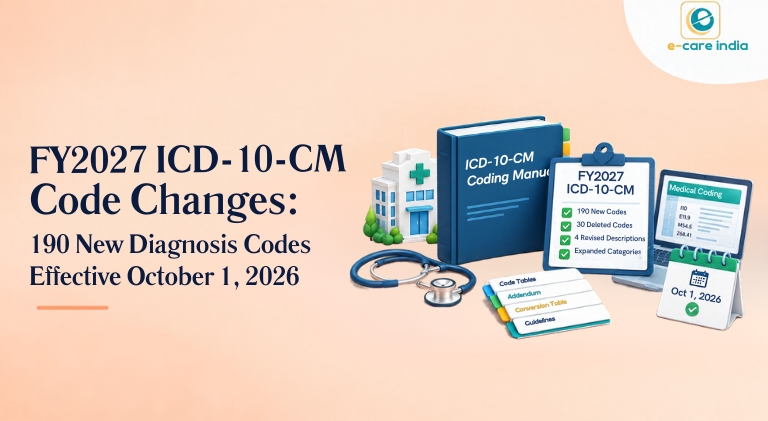
The FY2027 ICD-10-CM code update takes effect October 1, 2026, introducing new diagnosis codes, deleted codes, and expanded code categories that healthcare providers, medical coders, and billing teams must review.
CMS has released the FY2027 ICD-10-CM files for diagnosis coding applicable to patient encounters and discharges from October 1, 2026, through September 30, 2027.
FY2027 update includes 190 new diagnosis codes, along with deleted and revised codes affecting several areas, including injuries and poisoning, musculoskeletal disorders, pregnancy-related conditions, congenital conditions, circulatory diseases, and factors influencing health status.
Key Highlights of the FY2027 ICD-10-CM Update
The FY2027 ICD-10-CM update includes:
- 190 new ICD-10-CM diagnosis codes
- 30 deleted codes
- 4 revised code descriptions
- Existing codes expanded into more specific categories and replacement codes
- Report new codes only for applicable encounters or discharges occurring on or after October 1, 2026.
Also, CMS has published the FY2027 code tables, addendum, conversion table, and official coding guidelines for review.
What Is Changing in FY2027?
One key change in FY2027 is more specific diagnosis codes.
Some existing codes have been divided into more specific codes based on factors such as laterality, disease type, anatomical site, and clinical circumstances.
For example, dilated cardiomyopathy now includes more specific codes for unspecified, familial-genetic, and other forms of the condition. Similar changes provide more explicit specificity for other cardiomyopathies and cardiac arrhythmias.
This means coding teams should review whether a more specific FY2027 code is required, rather than continuing to use a broader parent code.
Major Areas Affected by the FY2027 ICD-10-CM Changes
The FY2027 update affects multiple ICD-10-CM chapters. Some of the notable areas include:
Injuries and Poisoning
The “Injury, poisoning and certain other consequences of external causes” chapter includes many new codes that make the classification more specific for toxicity effects and injuries.
Musculoskeletal Conditions
The new codes provide greater specificity for diagnoses including VEXAS syndrome, plantar fasciitis, and osteomyelitis, with site-specificity and laterality differentiation. Accurate medical records are especially necessary to code these diagnoses.
Pregnancy-Related Conditions
In addition to general codes for various pregnancy-associated disorders, the new update also introduces more detailed codes for specific conditions like ectopic pregnancy, including more detailed codes for various ectopic pregnancies, and persisting pregnancy after vanishing twin syndrome.
Circulatory System
Several new codes provide greater specificity for cardiovascular conditions, including dilated cardiomyopathy, arrhythmogenic cardiomyopathy, Brugada syndrome, and other cardiac arrhythmias. These changes may require updates to coding references and billing system configurations.
Other Clinical Areas
Additional changes affect neoplasms, digestive diseases, respiratory conditions, endocrine conditions, and factors influencing health status. The Z-code section, for example, includes new codes related to BMI, gadolinium exposure, burn-pit exposure, Agent Orange exposure, and blast overpressure exposure.
Deleted and Expanded ICD-10-CM Codes
The FY2027 update also includes deleted codes and changes to existing code structures.
A code that was previously reportable may no longer be appropriate for dates of service beginning October 1, 2026. Some existing codes have also been subdivided into more specific options, particularly in musculoskeletal, cardiovascular, BMI, and pregnancy-related coding.
Medical coding teams should review the FY2027 conversion table and addendum to identify codes that have been deleted, revised, or replaced.
Impact of the FY2027 Changes on Medical Billing
ICD-10-CM codes support diagnosis reporting and medical claim processing. Using an outdated, deleted, or incorrect code can contribute to:
- Claim Rejection/Denial
- Coding and Validation Errors
- Medical Necessity
- Inappropriate Payment
- Compliance
The increased specificity in several categories also makes accurate clinical documentation important when selecting diagnosis codes.
Steps to Implement the FY2027 Code Changes
Healthcare organizations can take several phases to prepare for the FY2027 changes.
Review the New Code Set
Review the FY2027 ICD-10-CM code tables, addendum, conversion table, and official coding guidelines and identify changes relevant to your specialties.
Identify Frequently Used Codes
Review commonly used diagnosis codes to determine whether they have been added, deleted, revised, expanded, or replaced with more specific codes.
Up-to-date EHR and Billing Systems
The EHR, practice management, and billing systems should have the right FY2027 code set. Review diagnosis pick lists, coding libraries, and claim-edit rules before filing FY2027 claims.
Review Documentation and Train Staff
Providers and coders must ensure the documentation supports the selected diagnosis codes. Medical coders and billers need training on the new codes.
Monitor Claims After Implementation
After October 1, billing staff should track rejection and denial rates due to ICD-10-CM problems. Analyzing denial trends may uncover inappropriate code assignment, system setup problems, or documentation issues.
Effective Date of the FY2027 ICD-10-CM Changes
The FY2027 ICD-10-CM code set applies to applicable patient encounters and discharges from October 1, 2026, through September 30, 2027.
New codes should not be used for dates of service before their effective date. Healthcare organizations should ensure their coding and billing systems are aligned with the appropriate code set based on the date of service.
Moving Forward With the FY2027 Code Set
The FY2027 update to ICD-10-CM adds 190 new diagnosis codes and makes other changes to various code structures. Health care organizations can prevent claim issues by reviewing revised codes, updating billing systems, improving clinical documentation, and training coders.
For accurate coding decisions, medical billing teams should refer to the official CMS FY2027 ICD-10-CM files and coding guidelines.
How e-care India Can Help
At e-care India, we understand the importance of keeping medical billing operations aligned with changing ICD-10-CM coding requirements.
Our medical billing services support healthcare organizations with medical coding, claim submission, payment posting, denial management, and other RCM processes.
Our team can help healthcare providers maintain accurate coding workflows and adapt billing operations to changing coding and payer requirements.
Need support with your medical billing and RCM operations? Connect with e-care India today.