Clean Claims in Medical Billing: How to Improve First-Pass Claim Acceptance
Table of Contents
- What Are Clean Claims in Medical Billing?
- Why First-Pass Claim Acceptance Matters
- Common Reasons Claims Are Denied
- Best Practices to Improve Clean Claims in Medical Billing
- The Role of Technology in Clean Claims Management
- How Clean Claims Help Reduce Claim Denials
- Why Choose e-care India?
- Conclusion
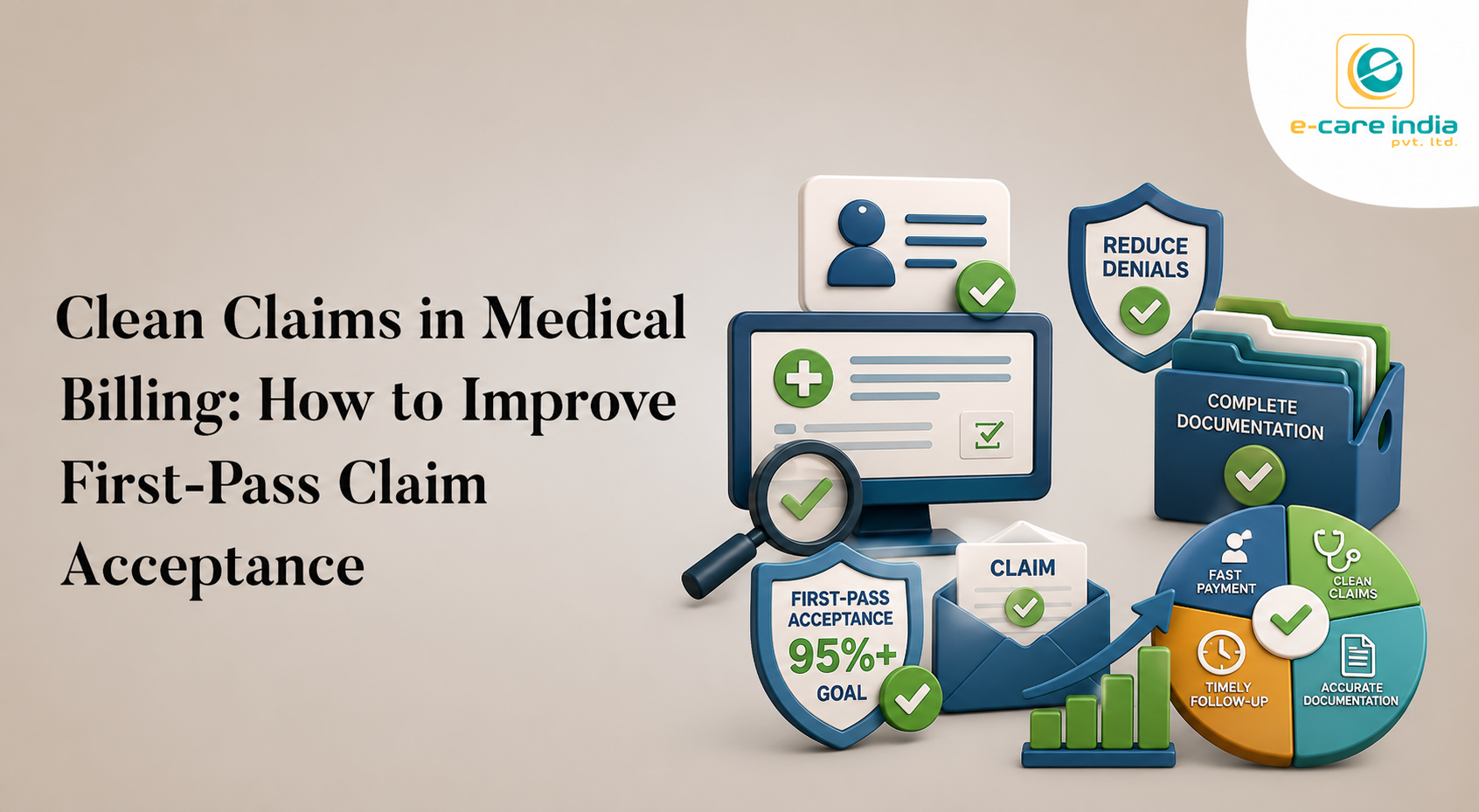
Healthcare providers face rising pressure to maintain financial stability while delivering high-quality patient care. However, one of the biggest challenges affecting the revenue cycle is claim denials. Even minor billing errors, incomplete documentation, or incorrect patient information can delay reimbursements, increase administrative costs, and impact cash flow. The key to overpowering these challenges lies in submitting clean claims in medical billing.
A clean claim is one that is not only clear but also accurate and satisfies all payer criteria on the first attempt. Healthcare providers who submit clean claims have higher success rates when their claims are accepted on the first pass and will receive their payments much quicker than those who don’t. Errors in claims usually necessitate corrections to be made.
A proper clean claim rate can be improved through accurate patient registration, accurate insurance verification, proper medical coding, clinical documentation, and quality control. Introducing a claim scrubbing process prior to claim submission will further help identify errors and ensure adherence to payer guidelines.
This blog post focuses on what clean claims are, the significance of first-pass acceptance, the reasons behind claim rejections, and some advice on how healthcare providers can improve claim accuracy.
What Are Clean Claims in Medical Billing?
Clean claims in medical billing are those that contain all the accurate and properly documented information needed for the insurer to process them without needing any additional information or making any changes.
Elements of a Clean Claim Include:
- Patient demographics
- Insurance data verification
- ICD-10 diagnostic codes
- Appropriate CPT and HCPCS procedure codes
- Proper use of modifiers
- Physician documentation
- Adherence to payer-specific billing policies
Since clean claims require little or no rework, they are processed more quickly, resulting in faster reimbursements and improved revenue cycle performance.
Why First-Pass Claim Acceptance Matters
First-pass claim acceptance is the ratio of claims being accepted and processed by insurance payers from the first attempt without any rejection or denial.
The benefits of higher first-pass acceptance rates include:
- More prompt insurance payment
- Minimal claim resubmission
- Reduced cost of administration
- Better cash flow
- Increased efficiency
- High level of patient satisfaction
- Superior revenue cycle management performance
Healthcare organizations with an emphasis on claims accuracy invest less time correcting mistakes and focus more on caring for their patients and achieving financial success.
Common Reasons Claims Are Denied
Understanding why claims are denied is essential for improving the clean claim rate and reducing unnecessary revenue loss.
1. Incorrect Patient Information
Patient’s name, date of birth, insurance ID number, or other demographic data can lead to claim denial upon entering this information.
Best Practice: Confirm patient information during appointment scheduling and at the point of check-in.
2. Insurance Eligibility Problems
The lack of insurance, expiration of the patient’s insurance, or non-coverage of procedures due to a lack of proper authorization or coverage is the main reason for claim denial.
Best Practice: Confirm patient’s eligibility and benefit plan prior to each patient visit.
3. Medical Coding Mistakes
Diagnosis, procedure, or modifier codes, as well as incorrect coding practice, are still one of the major causes of claim denials.
Best Practice: Use certified medical coders and perform coding audits regularly. Be aware of the ICD-10, CPT, HCPCS coding updates.
4. Insufficient Clinical Documentation
A lack of clinical documentation makes payers unable to determine the medical necessity of the process; therefore, claims are being rejected.
Best Practice: Ensure physician documentation is complete and supports the diagnoses and procedures billed.
5. Timely Filing Violations
Every insurance payer has specific claim submission deadlines. Missing these deadlines often results in non-payable claims.
Best Practice: Establish efficient workflows to submit claims promptly and monitor payer filing limits.
Best Practices to Improve Clean Claims in Medical Billing
Verify Patient Information Before Every Visit
Accurate patient registration is the first step toward submitting clean claims. Healthcare providers should verify:
- Patient demographics
- Insurance coverage
- Policy numbers
- Referral requirements
- Prior authorization status
- Contact information
Preventing front-end errors significantly improves first-pass claim acceptance.
Improve Medical Coding Accuracy
Medical coding directly impacts claim acceptance. Accurate ICD-10, CPT, HCPCS codes, and modifier selection ensure claims comply with payer guidelines.
Healthcare organizations should:
- Conduct routine coding audits
- Provide ongoing coder education
- Monitor coding accuracy
- Follow payer-specific coding updates
Accurate coding not only improves reimbursement but also helps reduce claim denials.
Strengthen Clinical Documentation
Accurate and complete clinical documentation helps demonstrate medical necessity and verify billed services.
It must include the following information:
- Diagnosis of the patient
- Details of the procedure performed
- Notes of the physician
- Treatment plan
- Medical necessity of the service
- Signatures
Strong documentation minimizes payer questions and supports faster claim processing.
Implement Claim Scrubbing Before Submission
One of the most effective strategies for improving the clean claim rate is implementing Claim scrubbing.
Claim scrubbing uses automated software and billing rules to review claims before submission, identifying potential errors such as:
- Invalid diagnosis codes
- Incorrect procedure codes
- Missing modifiers
- Incomplete patient information
- Payer-specific edits
- Duplicate claims
By correcting these issues before submission, healthcare providers improve first-pass claim acceptance, accelerate reimbursements, and significantly reduce claim denials.
Monitor Clean Claim Rate Regularly
Measuring your organization’s clean claim rate can offer valuable insight into how you bill. Monitoring is helpful because it helps spot recurring problems, measure process improvements, and ensure continuous improvement of the revenue cycle.
The following metrics should be assessed by an organization:
- Clean claim rate
- First pass claim acceptance rate
- Denial rate
- Days in accounts receivable
- Net collection rate
These metrics help billing teams proactively identify inefficiencies and improve overall reimbursement performance.
The Role of Technology in Clean Claims Management
Technology has been incorporated into the practice of medical billing in the modern era. Technology such as billing software is used by healthcare organizations to enhance the accuracy of the claims being filed while minimizing effort.
Claim scrubbing is one of the most useful technologies as it checks for missing elements, inconsistencies in coding, duplicate claims, payer edits, and formatting errors prior to submitting claims.
Apart from claim scrubbing, healthcare organizations benefit from:
- Eligibility check automation
- Real-time claim status monitoring
- Electronic claim filing
- Revenue cycle management dashboard
- Denials analysis
- Payment reconciliation
By integrating automation into the billing workflow, providers can improve the clean claim rate, reduce administrative costs, and accelerate reimbursements.
How Clean Claims Help Reduce Claim Denials
Submitting clean claims in medical billing processes is arguably one of the most pragmatic strategies to reduce claim denials. With clean claims, the claims process becomes efficient as they will not experience delays.
Advantages of submitting clean claims are:
- High first pass claim acceptance rate
- Shortened reimbursement time frame
- Low claim correction rate
- Lowered administrative work
- Increased cash flow
- Boosted patient satisfaction
- Effective revenue cycle management
Instead of dedicating time to appealing denied claims, a billing process will concentrate on implementing revenue cycle improvement strategies to ensure financial success.
Why Choose e-care India?
At e-care India, we understand that each denied or rejected claim impacts your business’s revenues and efficiency. Our experienced team of medical billing experts works alongside the healthcare providers to enhance the accuracy and efficiency of the billing process. Our complete medical billing services include:
- Insurance Eligibility Verification
- Charge Entry
- Medical Coding
- Claim scrubbing
- Electronic Claim Submission
- Payment Posting
- Denial Management
- Accounts Receivable Follow-Up
- Revenue Cycle Management
Using standardized quality assurance processes and experienced billing specialists, e-care India helps healthcare organizations improve first-pass claim acceptance, maintain a higher clean claim rate, and significantly reduce claim denials.
Whether you own a physicians’ practice, specialty clinic, hospital, or ambulatory surgery center, we have solutions that will help you increase your revenues and allow your employees to concentrate on caring for patients.
Conclusion
Submitting clean claims in medical billing is essential for improving revenue cycle performance and ensuring timely reimbursements. Every step of the billing process—from patient registration and insurance verification to accurate coding, documentation, and claim scrubbing—plays a critical role in achieving higher first-pass claim acceptance.
Through best practice execution, the use of technology, and continuous billing performance observation, healthcare organizations can be able to enhance their clean claims rate, reduce claim denials, and optimize their economic performance.
Working with a medical billing service provider such as e-care India will ensure that healthcare providers get industry insights, efficient billing methods, and revenue cycle management solutions that will help them grow sustainably.
Frequently Asked Questions
What is a clean claim in medical billing?
A clean claim in medical billing is a complete and error-free insurance claim that meets payer requirements and can be processed without additional information or corrections. Clean claims improve reimbursement speed and reduce administrative work.
How can healthcare providers improve first-pass claim acceptance?
Healthcare organizations can enhance first-pass claim acceptance through patient eligibility verification, medical coding accuracy, clinical documentation completeness, claim scrubbing, and timely claims submission.
What should be a good clean claims rate in medical billing?
Although benchmarks may differ, many leading healthcare companies strive to maintain a clean claims rate of over 95%. This can be achieved through auditing, proper coding, and sound billing practices.
How do clean claims help reduce claim denials?
Submitting clean claims in medical billing minimizes errors related to patient information, coding, documentation, and payer requirements. This leads to higher acceptance rates, fewer denials, faster reimbursements, and improved revenue cycle performance.