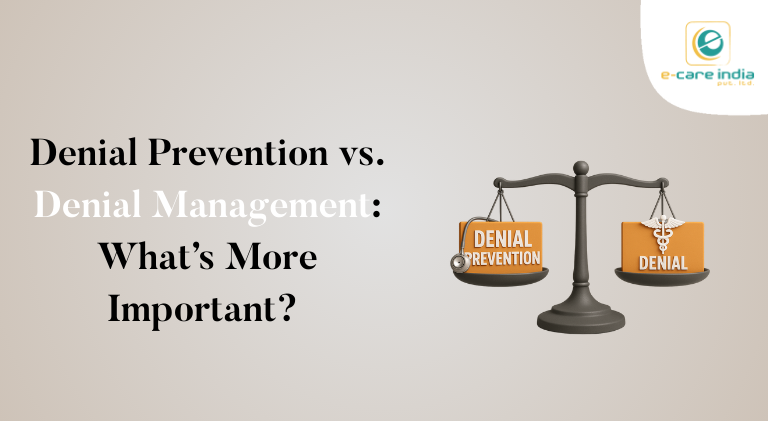
Denial Prevention vs. Denial Management: What’s More Important?

To date, claim denials continue to siphon off valuable time, money, and resources of any medical practice and hospital in the healthcare revenue cycle. Each denied claim stands for delayed payment, increased workload, and loss of possible revenue. It is worth comprehending the huge difference between denial prevention and denial management in medical billing concerning financial stability.

While both are essential to maintaining healthy cash flow, many a provider remains torn as to where the pendulum should swing more: should they be working on stopping denials before they happen, or spend more effort fixing them once they occur? Let’s break down both concepts and find out which matters most in the long run.

In the paper, some case studies related to the communication complexity of modules in large distributed systems are described.

What is Denial of Service Prevention?

Denial prevention means finding and correcting potential billing errors proactively before claims are presented to payers. This eliminates unnecessary rework and reduces the overall denial rate.

How Denial Prevention Works:

Verify insurance eligibility at or before the point of service

  • Ensuring accuracy of patient data input.
  • Correct utilization of CPT, ICD-10, and HCPCS codes
  • pre-authorization verification along with medical necessity
  • Review of documentation and modifiers for accuracy

When these steps occur, a large percentage of denials never happen in the first place. In fact, over **60% of denials are preventable** if proper front-end processes are followed, according to industry studies.

What is Denial Management?

Denial management is the  process of analysing the root cause of a denied claim, correcting it, and successfully resubmitting the same.

Typical denial management tasks include:

  • Reading and understanding payer denial codes
  • Identifying gaps in documentation
  • Appealing claims within payer timelines
  • Tracking patterns and trends in denials

So, What’s More Important?

Of the options, denial prevention provides the most value in the long term if health care providers must choose. Preventing claim errors saves time, reduces administrative costs, and ensures quicker reimbursement. However, it is not possible to ignore the management of denial completely. Not even the best systems can avoid all denials as payer rules constantly change. The best results are derived through a balanced strategy:

Start with solid denial prevention processes that reduce preventable denials A successful revenue cycle depends on a combination of both approaches.

denial management in healthcare system enables providers to safeguard revenue, boost productivity, and ensure stronger financial performance. Whether it’s the front or back end of the billing team, working in tandem drives down denial rates, improves reimbursement, and ensures patient services are not interrupted. In today’s competitive healthcare environment, that’s not just helpful-it’s essential. —
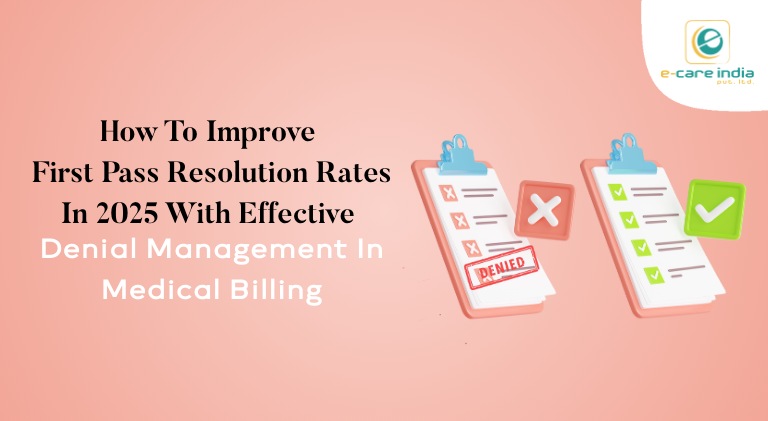

How To Improve First Pass Resolution Rates in 2025 with Effective Denial Management In Medical Billing

With the ever-evolving healthcare landscape of 2025, effectiveness in the revenue cycle is high on the list of priorities among providers. The single most significant performance metric within medical billing is the First Pass Resolution Rate (FPRR), the percentage of how often the claims get paid out on the first submission without denials or redrafts. While sophisticated reimbursement mechanisms become prevalent, an increased FPRR depends significantly on efficient Denial Management in Medical Billing.

At e-care India, we realize that denial management is more than an after-the-fact activity but rather a strategic process at the heart of revenue cycle excellence.

Why First Pass Resolution Is More Important Than Ever?

High FPRR reduces administrative headaches, accelerates cash flow, and improves patient satisfaction. However, in 2025, providers are faced with:

Increased payer policy changes
More claim edits and audits
Stringent documentation requirements

Without active Denial Management in Healthcare, this can have the potential to create an exponential growth of denials, rework expense, and late payments.

We at e-care utilize a technology-enabled and data-driven approach to Denial Management in medical billing, enabling our clients to reduce rejections and get paid more quickly.

Key Strategies to Enhance First Pass Resolution with e-care India

Pre-Bill Scrubbing and Validation

We do full validation checks even prior to sending a claim to the payer. It involves demographic correctness, insurance verification, and coding compliance—functioning for minimizing errors that lead to denials.

Automation-Backed Denial Tracking

Our denial management system isolates and tracks denials by reason codes, payers, and frequency. It helps us detect trends in real time and correct root causes in advance.

Clinical and Coding Competence

e-care’s professional coders and clinical documentation improvement experts ensure claims are accurately coded the first time—reducing medical necessity and coding-related denials.

Payer Rule Intelligence

Our billing engine is updated on a regular basis with payer-specific edits and rules. This allows us to tailor claim submissions and predict potential red flags resulting in rejection.

Shared Feedback Loops

We foster collaboration between client practices and billing teams by transmitting monthly denial performance dashboards. This aligns stakeholders and fosters responsibility.

Results that Speak for Themselves

With our leading-edge Denial Management in Healthcare processes, e-care India customers typically see:

15–25% boost in First Pass Resolution Rates

30% reduction in A/R days

40% fewer denials on average within 3-6 months

Future-Ready Denial Management for 2025 As AI, machine learning, and payer analytics redefine medical billing, denial management will no longer be reactive—it must be predictive and preventive. At e-care India, we’re investing in advanced denial prediction tools and real-time dashboards that help healthcare providers stay ahead of claim denials before they happen.

As of 2025, the days of healthcare organizations being able to support the cost of poor denial management are gone. Alignment of denial prevention initiatives with best practices in Denial Management in Medical Billing will radically improve First Pass Resolution Rates, speed up revenue cycles, and reduce operating burden.

Team up with e-care India to transform your denial management processes and realize quicker payments with less rejection.

How To Avoid And Manage The Medical Claim Denials?

Denial Management

Medical billing is one of the major factors to decide the financial success rate of the practice, and claim denials affect the cash flow of the practice. Every new claim denials lead to revenue leaks. That’s why denials look like a painful financial drain on practices. For better claims denial management, you have to identify the denials and reasons of the denials. Avoiding and reducing the claims denials will improve the cash flow. Let’s discuss the claims denial management and strategies to avoid and manage the claim denials.

Continue reading “How To Avoid And Manage The Medical Claim Denials?”

Medical Billing – Double your growth in 2019!


Managing a medical billing company is not an easy task, as one has to face a lot of challenges besides competing with other companies in the domain. Have you ever analyzed as to where you rank in relation to your competition? If not, do it right away! Once a thorough analysis has been made, you will know whether your company is in need of expansion to be amongst the top 10 in the country. Continue reading “Medical Billing – Double your growth in 2019!”

Medical Coding Services: Benefits of Having Medical Coding Services

A lot is going on in the healthcare industry in the US, and medical coding providers are finding it increasingly harder to keep up with the latest updates and changes. This often results in the shortage of qualified professionals who can deliver accurate medical codes for timely reimbursements. If your organization is suffering from revenue constraints due to denied claims, maybe it’s time to outsource this task to an offshore company that offers medical coding services. Continue reading “Medical Coding Services: Benefits of Having Medical Coding Services”

How soon can you start saving when using Offshore Medical Billing?

offshore medical billing ecare

Due to the recent changes in the US healthcare domain, the onus of providing medical billing services with consistent quality has increased for the US based medical billing companies.  The offshore medical billing model has become a ‘hard to avoid’ option in recent times. Evidently, many outsourcing medical billing companies in the US consider it a better option than to expand their team of employees. Continue reading “How soon can you start saving when using Offshore Medical Billing?”

ICD-10 Impact on the Revenue Cycle

Right from Healthcare Providers to medical billing companies, everyone in the US is looking forward to one major change, which is the ICD-10 implementation. Though the transition of ICD-10 code sets will come into effect only by 1st October 2014, Healthcare Providers and Facilities and onshore and offshore medical billing companies have already started preparing for the change. Continue reading “ICD-10 Impact on the Revenue Cycle”

Importance of Quality in Medical Billing

What is quality?

To sustain growth in the competitive environment, organizations need to create and retain satisfied clients. To achieve this goal, organizations have to provide services, value for money, meet the client’s requirements and service level agreements as well as deliver on time. In short, each and every organization needs to provide quality services. ‘Productivity without quality does not yield anything’. Continue reading “Importance of Quality in Medical Billing”